Nexus HeadroomStrategy work for one school at a time
Senior strategy work, sized for one school.
A head is leaving, enrolment has moved, or the board has asked for a plan. Nexus Headroom does one fixed piece of senior strategy work for a single independent school in Southeast Asia — Malaysia, Thailand, Vietnam, Indonesia and the Philippines: scope, price and timeline agreed before it starts, delivered in days.
Three tiers, from USD 5,000. Five to fifteen business days. One PDF.
What Nexus Headroom is here to do
Close the gap under the consultancy floor
A strategy consultancy has a minimum engagement. A single school sits below it. That is the gap. We do senior strategy work at the size of one question, priced before it starts.
Serve the school that decides for itself
Proprietors, foundations and trusts, yayasan and church-mission schools, local groups of two to five. Platform groups and listed operators have their own strategy functions; this is not for them.
Settle the one question of the year
A head leaving or arriving. Enrolment under pressure. A repositioning, an expansion, an owner's succession or exit, margin or regulation closing in. One question, one document, delivered in days.
Decide everything before the work starts
Scope, price and timeline are fixed in writing before anything begins. No open-ended fees, no second phase you did not ask for. Nothing is added midway. Nothing runs on.
Say plainly where AI did the work
The work is AI-supported, and we say so. A senior strategist reviews it before it reaches you. What is automated is shown as automated.
Six of the twelve products
Each product delivers three named parts as one shareable PDF. The name, the scope and the price are the same for every school; only the situation differs.
Strategic Snapshot
Peace of mind · USD 5,000 · about five business days · for the head deciding alone: an owner-head, no board above
The current state on a page: fee income, cash, families, staff and leadership.
The transition risks, ranked by impact and likelihood, each with a first response.
A 30-day action map, week by week, to hold momentum through the gap.
The right one when the head's seat is changing and you want a reliable baseline before the next head walks in.
Board-Ready Situation Report
Peace of mind · USD 5,000 · about five business days · for the head under a board, foundation or owner
A board situation summary: the headline numbers and what is under control, on one page.
An independent diagnostic of enrolment and fees, finances, operations, staffing and governance, each rated by an outside eye.
The board narrative, with answers prepared for the questions the board will ask.
The right one when the board has asked where the school stands and wants to hear it from someone outside.
Transition Blueprint
Transition support · USD 10,000 · about ten business days · for the head deciding alone
A 30-60-90-day plan for the incoming head: stabilise, decide, deliver.
A stakeholder map: who matters, what they expect, the first move with each.
The new head's landing zone: quick wins, waiting decisions, key relationships, a first-day checklist.
The right one when a new head is appointed and you want to hand over a runway, not a blank page.
Board-Aligned Transition Blueprint
Transition support · USD 10,000 · about ten business days · for the head under a board, foundation or owner
A 30-60-90-day plan for the incoming head, each phase tied to what the board expects and the measure agreed for it.
Board and head alignment: the board's priorities, the head's plan and the agreed measures, side by side.
Governance and measures: how often the board hears, who decides what, and which numbers it tracks.
The right one when a new head is named and board and head need the same first term in writing before day one.
Growth Strategy Sprint
Strategy change · USD 20,000 · about fifteen business days · for the head deciding alone
Where the growth is: opportunities across catchment, programme and admissions, sized and ranked.
The growth moves worth making, with effort, impact and order.
An admissions acceleration plan: fees, channels, how families find you, the trajectory and the targets.
The right one when enrolment has moved and the question is where the next families come from.
Board-Level Strategy Foundation
Strategy change · USD 20,000 · about fifteen business days · for the head under a board, foundation or owner
Strategy on a page: vision, pillars, the financial ambition and the ask, in the board's format.
Strategic choices: where the school plays, how it wins, and a three-year financial plan.
The investment case: the ask, the return, the risks and the decisions the board is asked to make.
The right one when the board has asked for a strategy it can endorse and you still have a school to run.
These are six of twelve. The suite ladders in three tiers — Peace of mind, USD 5,000, about five business days; Transition support, USD 10,000, about ten; Strategy change, USD 20,000, about fifteen — and each tier holds two products for a head deciding alone and two for a head under a board, foundation or owner. Every product is advisory. It sets out the position and the options; the decisions, and their outcomes, stay with the school.
How it works
One conversation with Raymond, by email or on a call: what the situation is and whether one of the products fits. If none does, that is the answer.
A written offer fixes the three parts delivered, what is excluded, the price and the timeline. It holds for fourteen days. You decide; nothing happens until you order.
One intake call and the documents you already have; then the work, AI-supported and reviewed by a senior strategist, returned as one shareable PDF in about five, ten or fifteen business days, as agreed. Paid in full on order; the work begins on receipt.
One walkthrough call, then it is yours: advice, not a guarantee of results. What to act on, who sees it, whether to come back: the school's decisions. Nobody calls again unless asked.
Who is behind Nexus Headroom
Raymond Wallstead, BA, JD
Venture Lead, International Schools. Raymond leads our International Schools division. With nearly 20 years of experience teaching in Southeast Asia, he has worked in local schools, universities and international schools, and runs a tutoring centre in Phuket, Thailand. He convenes the survey below, and he is the person a head talks to here.
NexusSpearhead is the small strategy desk behind Nexus Headroom. It does senior strategy work at fixed scope and fixed price for organisations that cannot buy it conventionally, AI-supported and reviewed by a senior strategist. Nexus Headroom is its initiative for independent schools in Southeast Asia, run by its International Schools division.
What follows asks nothing of you but ten minutes: a survey of heads and boards, convened by Raymond as an educator, confidential, with the results sent back to every school that asks for them, and nobody calls unless you tick the box.
Private Schools Southeast Asia 2027Survey of Heads and Boards
Where does your school sit against its peers this year?
A peer survey of heads and boards at private and international schools in Southeast Asia — Malaysia, Thailand, Vietnam, Indonesia and the Philippines. About ten minutes. Sixteen questions, all multiple choice. No market questions, no right answers.
Open until 20 November 2026. Results in January 2027. Confidential: reported as counts and shares only.
What you get back
The results, in January 2027
The aggregate of what heads and boards across the region told us: where enrolment is going and who drives it, the concerns that rank highest, fee intentions, how hard hiring was this year.
A one-page position sheet for your school
Your own answers set against peers of the same ownership type and size, written so you can put it in front of your board without editing.
The first published picture of how schools here get strategic work done
Who does the work, who signs it off, whether outside help was ever used and what it cost. Nobody has published it — see why below.
What it asks
Your year
Where enrolment is heading and which families drive it, the three things that concern you most, what you plan on fees, and how recruiting went this cycle.
The one thing you'd settle this year
The strategic question you'd most like off your desk, how far along it is, who has to be convinced, and what would most help get it done.
How strategic work gets done at your school
Who did the work last time and how it went, whether there is a written plan, whether outside help was ever bought, and where you turn for a second opinion.
Answer for your own school and your own year. If a colleague on your board or leadership team would answer some of these differently, they are welcome to complete their own copy — two views from one school are more useful than one.
Why this survey, why now
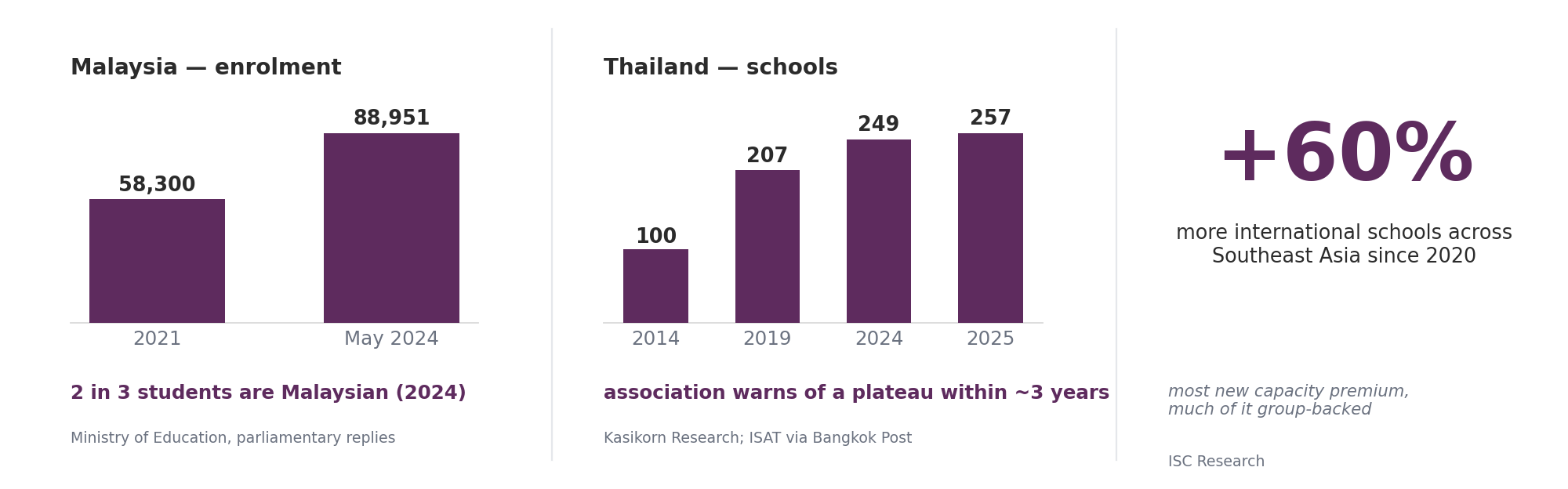
Market data on this sector is plentiful: school counts, enrolment, fee levels, who owns what. The picture it paints is not "expat decline" but growing dependence on local demand, now meeting demographic decline and premium oversupply at the same time.
Ministry of Education Malaysia (parliamentary replies); Kasikorn Research and ISAT via the Bangkok Post; ISC Research.
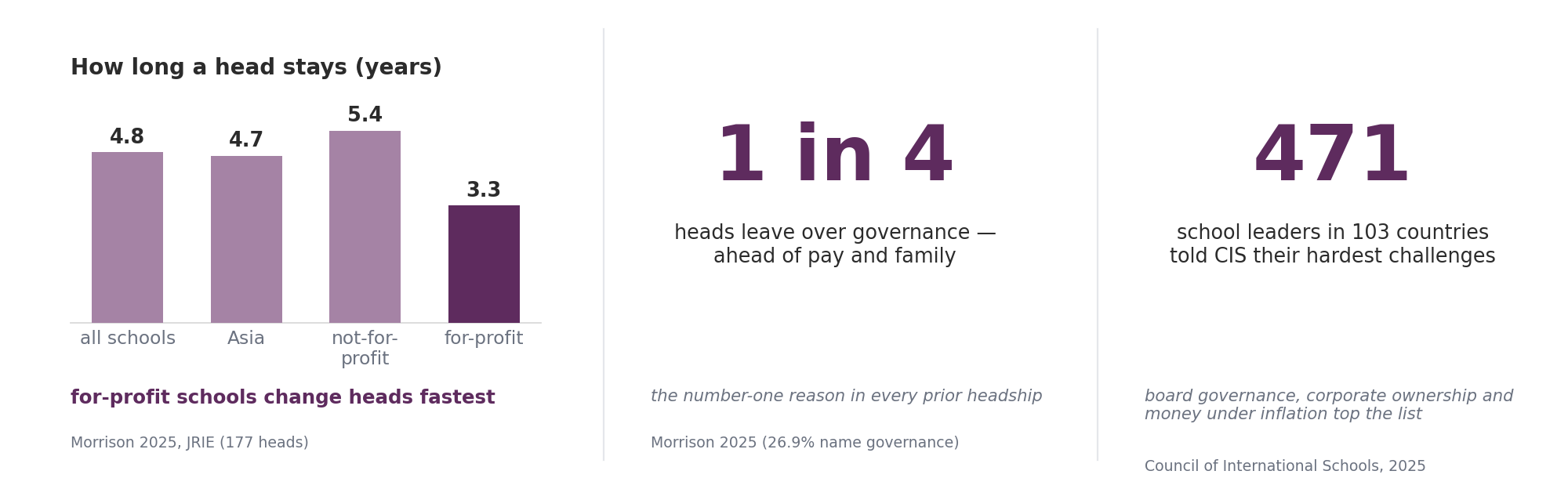
What heads themselves say gets in the way is governance: it tops the challenge list in a 471-leader global survey, and it is the number-one reason heads leave. Both studies are global and skew towards large accredited schools. Nobody has asked the independent schools of Southeast Asia — or published how a single school actually gets strategic work done. That is the gap this survey fills.
Morrison 2025, Journal of Research in International Education; Council of International Schools, 2025.
Confidential, and the honest line
Your answers are confidential. Results are reported as counts and shares only, never a school by name, and never for a group of fewer than five schools. Your email address, if you give it, is used only to send you the results and your position sheet and, if you ask for it, to arrange one conversation about them. Nothing else.
Raymond convenes this survey as an educator. He also leads Nexus Headroom, the initiative described above, which supports schools on exactly these questions. This survey is not a sales exercise: nothing is sent and nobody calls unless you tick the box at the end of it.
Who is behind it
Raymond Wallstead
With nearly 20 years of experience teaching in Southeast Asia, Raymond has worked in local schools, universities and international schools. He runs a tutoring centre in Phuket, Thailand.
Everyone who asks for them receives the results and their position sheet in January 2027. Those who tick the conversation box hear from Raymond from 19 January 2027 to find a time — not before.
Timeline
6 October 2026Survey opens
20 November 2026Survey closes
23 November – 19 December 2026Answers processed and the report written
January 2027Results and position sheets sent to everyone who asked for them
19 January – 27 February 2027Optional twenty-minute conversations for those who ticked the box
Sources
Every number on this page and inside the survey, with where it comes from.
All sources
Enrolment and market
Ministry of Education Malaysia figures via parliamentary replies (88,951 students, 67.1% citizens, May 2024; 58,300 in 2021): The Edge Malaysia; GSI Education
Thailand growth and saturation warning (275 schools, 92,960 students, 2025): Bangkok Post
Morrison, A. R. (2025). Survival at the top: head of school tenure in international schools. Journal of Research in International Education, 24(2). Open access: doi.org/10.1177/14752409251366803
Council of International Schools (2025). Professional and personal challenges facing school leaders around the world: cois.org
ISC Research teacher movement survey: ISC Research